
Most homeowners never think about what’s running behind their walls. Then a renovation happens, or a slow leak, or a burst line, and suddenly the same old debate comes up: PEX or copper?
There’s no single right answer to copper plumbing vs PEX. It depends on your building’s age, how the existing lines are routed, your budget, and what you’re actually trying to accomplish. In New York, that math gets more complicated than it would in a typical suburban house.
A pre-war brownstone on the Upper West Side has almost nothing in common, plumbing-wise, with a gut-renovated condo in Long Island City. Different wall cavities. Different code history. Different water pressure coming off the city main. Copper’s been the default here for generations. PEX is newer, cheaper to install, and shows up constantly now in renovations where opening walls just isn’t an option. Once you know how each one actually holds up under real New York conditions, the decision gets a lot easier.
Copper Plumbing vs PEX: Understanding the Basics
Copper pipe is rigid metal, joined with soldered or press fittings, and it’s been the standard for residential water supply since the mid-20th century. Plenty of co-ops and townhouses out in the outer boroughs still run on copper installed decades back — some of it original to a 1960s or ’70s renovation that nobody’s touched since.
PEX, short for cross-linked polyethylene, is flexible plastic tubing built specifically for potable water. Rather than cutting and joining a bunch of short rigid sections, a plumber can run one continuous length from a manifold straight to a fixture. Fewer joints. Fewer spots for a leak to start.
When people talk about copper vs PEX plumbing, they’re really comparing two systems that have both proven themselves — just in different ways, and under different conditions.
What Is Copper Plumbing?
Copper has a long track record in this city. Buildings from the postwar era through the 1980s were routinely piped in it, and a lot of that original material is still doing its job just fine.
Its strengths hold up: a long service life when installed correctly, high heat resistance, stable performance under constant city water pressure, and rodents can’t chew through it. It’s fully recyclable too, for whatever that’s worth to you.
The tradeoff is labor. Copper takes real time to install — cutting, cleaning, fitting, soldering every joint by hand — and it needs a plumber who genuinely knows the craft, not someone learning on the job. On top of that, copper’s a commodity metal, so material costs move with the market and aren’t always predictable month to month.
What Is PEX Plumbing?
PEX showed up in the U.S. later than copper but caught on with contractors fast, mostly because it’s just so much easier to route. A plumber can snake flexible tubing around framing and obstacles without stacking up a string of elbows and couplings, and that matters a lot in a building where every extra fitting is one more thing that could eventually fail.
The advantages line up well for renovation work: faster to install, cheaper materials, more flexibility around tight framing, better behavior when a pipe freezes, and it’s noticeably quieter — no water hammer banging through the walls at 2 a.m.
That combination is a big reason new residential construction across the five boroughs leans so heavily on PEX these days.
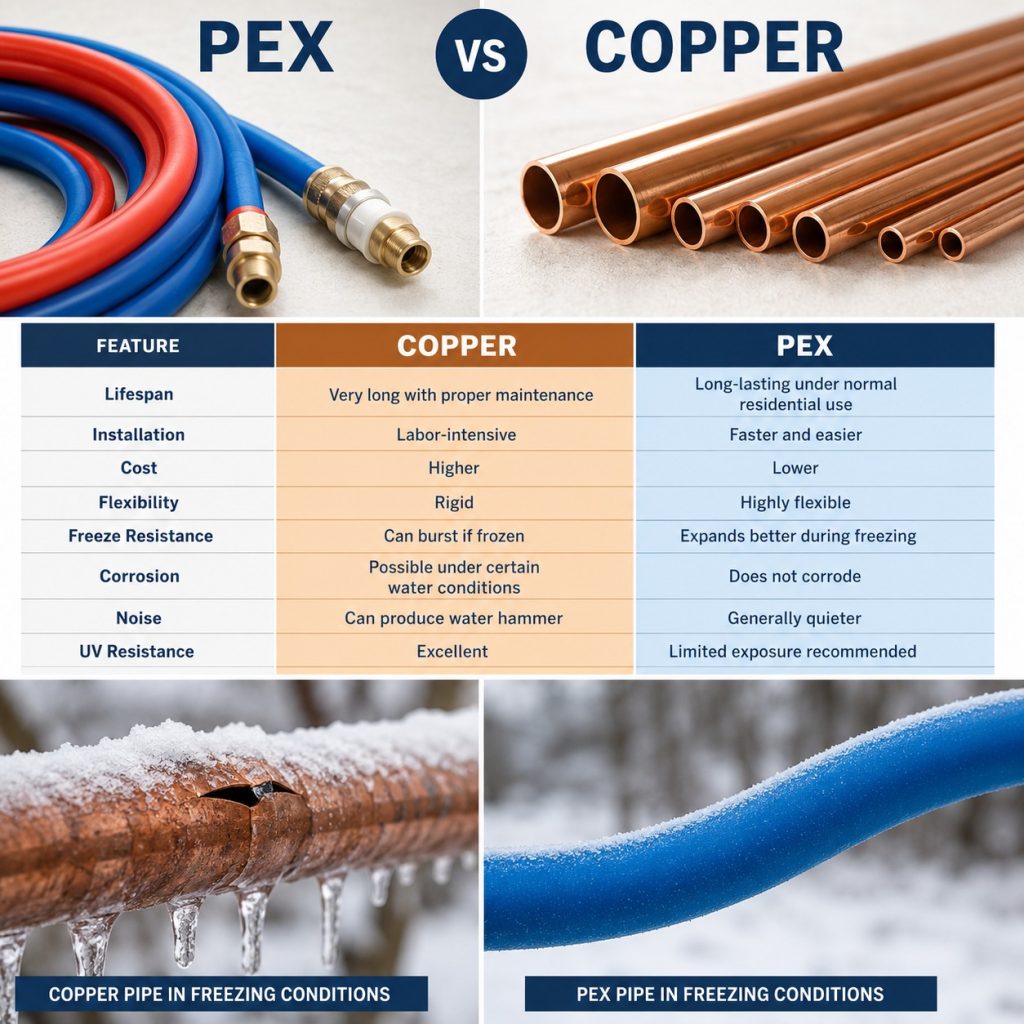
PEX vs Copper Pipes: Side-by-Side Comparison
| Feature | Copper | PEX |
|---|---|---|
| Lifespan | Very long with proper maintenance | Long-lasting under normal residential use |
| Installation | Labor-intensive | Faster and easier |
| Cost | Higher | Lower |
| Flexibility | Rigid | Highly flexible |
| Freeze resistance | Can burst if frozen | Expands better during freezing |
| UV resistance | Excellent | Limited exposure recommended |
| Corrosion | Possible under certain water conditions | Does not corrode |
| Noise | Can produce water hammer | Generally quieter |
Neither pipe wins across the board here.
Which one actually makes sense comes down to what your building needs,
not what looks best on paper.
PEX Pipe vs Copper Pipe: Which Lasts Longer?
Longevity is usually the thing that tips a full repipe decision one way or the other.
Copper earned its reputation the hard way — a properly installed system can run for decades, and plenty of New York buildings still have original copper supply lines that have never given anyone a moment’s trouble. That said, it’s not invincible. Certain water chemistry can lead to corrosion over time, and mineral buildup or a history of patched-together repairs will eventually shorten a line’s useful life.
PEX doesn’t corrode, and mineral deposits don’t bother it the way they can bother copper. It also tolerates a bit of movement inside a wall cavity — settling, minor shifts — without developing the kind of stress fractures that eventually turn into leaks down the road.
So PEX pipe vs copper pipe isn’t really about which one racks up more years on paper. It’s about how each one holds up against the specific stresses inside your walls. A brownstone that’s been renovated three times over the decades might be a better candidate for PEX, simply because of the flexibility it offers during the work itself. A landmarked building trying to preserve its original systems might just stick with copper for the sake of consistency. And a unit that’s dealt with frozen pipes before — say, a converted loft with exterior-facing plumbing runs — often does better switching to PEX going forward. Either way, a licensed plumber should inspect the existing system before recommending one material over the other.
Installation Differences: Labor, Time, and Complexity
Installation cost tends to catch homeowners off guard more than the price of the material itself does.
Copper means cutting, cleaning, fitting, and soldering every single joint by hand, and in a finished apartment with limited wall access, that adds up fast. PEX moves a lot quicker. Since the tubing flexes around obstacles instead of needing an elbow at every turn, a plumber can route it with far fewer connections — which also means fewer potential leak points down the road.
For a New York renovation, that difference shows up as less demolition, shorter project timelines, lower labor costs, fewer holes cut into finished drywall, and easier routing through tight crawl spaces or century-old framing. It’s most obvious on whole-home repiping jobs, where every extra hour of labor and every extra section of opened wall adds real, noticeable cost.
Cost Comparison: Copper Pipe vs PEX
Material prices move around, but copper almost always costs more upfront than PEX, and that gap only widens once labor gets factored in.
A copper job usually involves more fittings, a longer install window, specialized soldering or press tools, and higher material costs across the board. PEX generally means less labor, fewer fittings, faster routing, and lower material costs overall.
That said, the cheapest quote isn’t automatically the smartest long-term move. Your plumbing layout, how accessible the lines actually are, and whether you’re planning future renovations should all factor into the decision, not just the number on the first estimate. If more remodeling is coming down the road anyway, it’s worth talking to your contractor now about plumbing access, so you’re not reopening walls a second time.
And if a project already involves replacing aging fixtures, that’s often a good moment to upgrade faucets or deal with worn supply lines while everything’s already open. Plenty of homeowners pair a repiping job with leak detection or pipe repair, just to catch hidden problems before the walls close back up.
Which Pipe Performs Better in NYC’s Climate?
New York winters are hard on plumbing. Cold snaps raise the risk of frozen pipes, and a huge share of the city’s housing stock has been modified and re-modified over the decades — original lines patched, extended, or partially replaced by whoever owned the place before you did.
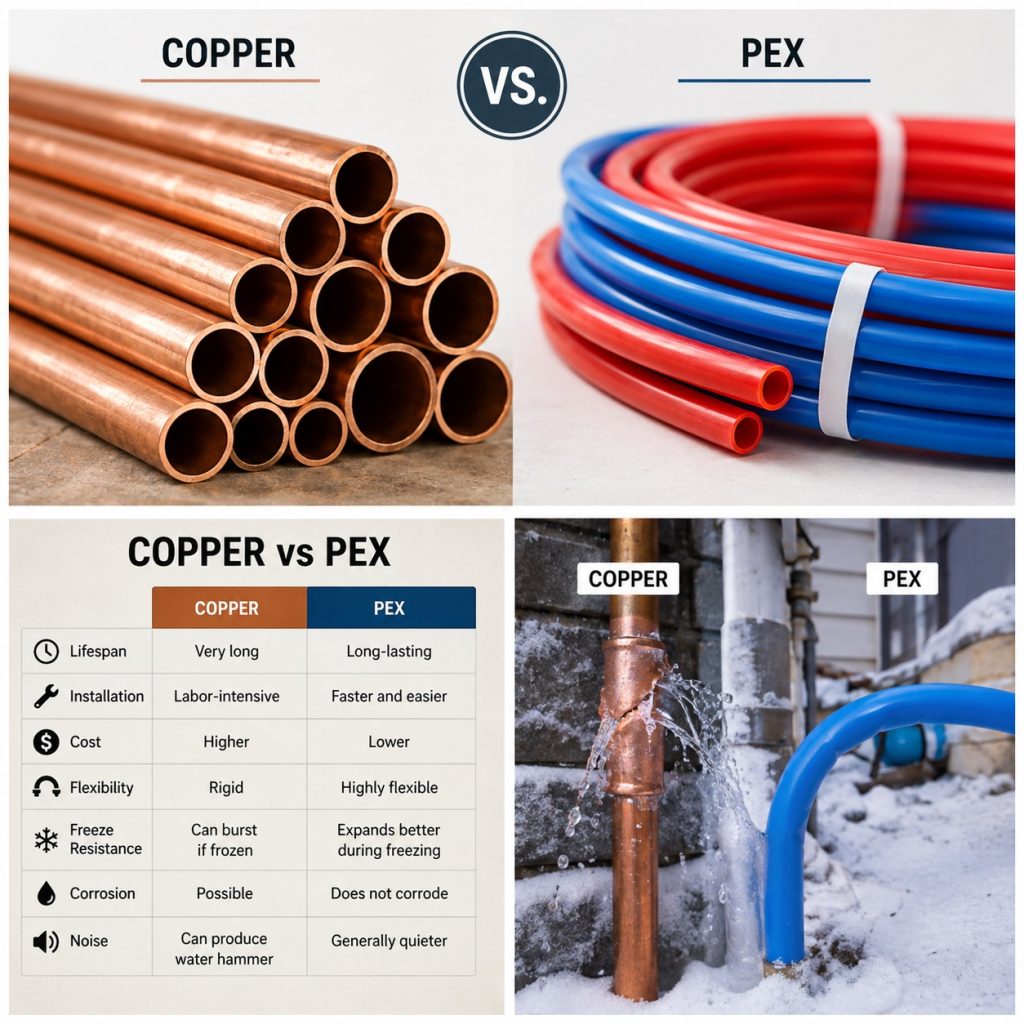
Freeze resistance is one of the main reasons people end up comparing PEX plumbing vs copper in the first place. Copper’s strong, but it doesn’t give at all when water inside it freezes. Ice expands, pressure builds fast, and the pipe can split right open. PEX has some give to it — the tubing can expand slightly and return to shape after a thaw. That doesn’t make it freeze-proof; any pipe can fail in a hard enough freeze. But it does cut down the odds of an outright burst in a lot of situations.
None of that replaces proper insulation, though. Pipes running through exterior walls, crawl spaces, or an unheated basement need to be wrapped no matter what they’re made of, especially in an empty apartment over a cold weekend when nobody’s around to catch a problem before it gets bad.
Maintenance and Common Problems
Neither material is maintenance-free, and it helps to know what to actually watch for with each one.
Copper systems tend to develop pinhole leaks from corrosion under certain water conditions, mineral buildup that gradually restricts flow, joint failures as a system ages, and repair costs that run higher because of the soldering work involved. Most of this develops slowly — which is exactly why routine inspections are worth doing in an older New York building. By the time you notice a stain on the ceiling, the leak’s usually been there a while already.
PEX needs less upkeep overall, but it’s not trouble-free either. Prolonged UV exposure before installation can degrade it, sloppy fittings or rushed installation cause problems down the line, sharp tools during a later renovation can nick the tubing, and — rare, but it happens — rodents have been known to chew through it. Professional installation cuts the risk on nearly all of these fronts significantly.
Which Is Better for Remodeling Older NYC Homes?
A lot of New York’s housing stock just wasn’t built with modern plumbing renovations in mind. Brownstones, prewar co-ops, and older apartment buildings often have tight wall cavities, framing that doesn’t follow any current standard, and decades of prior repairs hidden behind plaster nobody’s touched in fifty years.
That’s exactly where PEX vs copper plumbing stops being a purely technical comparison. PEX can often be fished through existing wall cavities with minimal demolition, since the tubing bends around corners and obstructions that would stop a rigid copper run cold. That means plumbers can frequently skip tearing into large sections of drywall or plaster — a real advantage in a co-op, where every hole in a shared wall might also need board approval before anyone can even start.
Copper still makes sense in plenty of situations: matching into an existing copper system, handling a partial repair instead of a full repipe, meeting a building’s specific requirements, or running exposed plumbing where the look of the finished pipe actually matters to someone. Every job’s different, and an experienced plumber will weigh accessibility, the building’s existing infrastructure, and its overall condition before recommending either route.
When Should You Call a Licensed Plumber?
Some plumbing issues are fine to just keep an eye on. Replacing supply lines usually isn’t one of them. Call a licensed plumber if you’re seeing:
- Recurring leaks
- Rust-colored water coming out of the tap
- Low water pressure throughout the unit
- Visible corrosion on exposed pipes
- Water stains on walls or ceilings
- Frozen or burst pipes
- Any major renovation that touches the plumbing
A professional can tell you whether a targeted repair will actually hold, or whether you’re better off just biting the bullet on a full repipe. If a leak’s already caused water damage, it’s worth scheduling leak detection before any pipe replacement — moisture can sit inside a wall cavity long after the visible damage gets patched up.
It’s also pretty common for homeowners replacing aging supply lines to have nearby systems checked at the same time, whether that’s water heater repair needs or shut-off valves just as old as the pipes themselves.
How to Decide Between PEX and Copper
The right choice isn’t about picking whatever’s newest, or whatever’s traditional. It’s about matching the material to your building. Before deciding, it’s worth thinking through how old your existing plumbing actually is, whether you’re replacing one section or repiping the whole unit, how much wall damage you’re willing to live with, what your renovation budget actually looks like, whether you’ve dealt with frozen pipes before, and whether more remodeling is coming down the line.
A licensed plumber can walk your layout, test your water quality, and look at what’s already installed before pointing you in a direction. For most modern renovations, PEX offers real value through its flexibility and lower installation cost. Copper’s still the right call for homeowners who want proven durability, strong UV resistance, and a system that ties in cleanly with what’s already there.
Final Thoughts: PEX or Copper Plumbing?
There’s no single answer to PEX or copper plumbing that fits every building. Both materials perform well when they’re installed right, and you’ll find both running through homes all over New York.
If affordability, faster installation, and better freeze resistance matter most to you, PEX is probably the better fit. If you’d rather have a rigid, time-tested material that integrates cleanly with an existing copper system, copper’s still a strong option.
The right call comes from an honest look at your building’s actual condition, not from chasing whatever trend is popular this year. A professional assessment will catch hidden issues, give you a real installation estimate, and point you toward whichever material will genuinely perform best for your property.